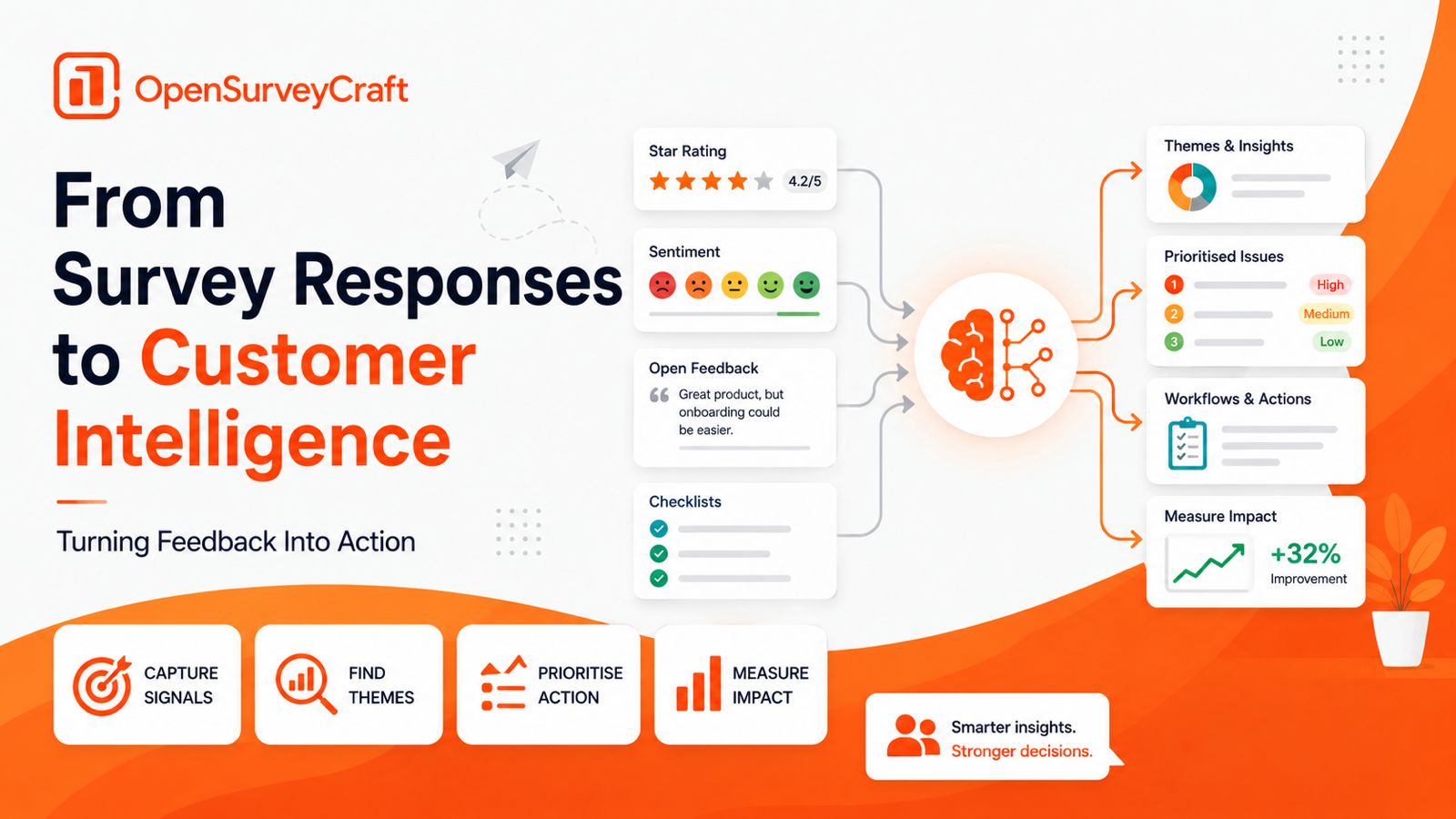
For B2B SaaS and fintech teams, the challenge is rarely collecting customer feedback. Most companies already run post-purchase surveys, onboarding questionnaires, NPS programmes, support follow-ups, in-app polls, product feedback forms, and those “quick two-minute surveys” that somehow feel longer than a procurement review.
The problem is not collection. The problem is conversion.
Too much feedback is gathered, reported, discussed in meetings, converted into dashboards, and then left untouched. Teams may know customers are unhappy. They may know satisfaction scores are falling. They may even know which part of the product, service, or onboarding journey is causing friction.
But they often struggle with the questions that matter: Who owns this issue? Which customers are affected? Is this a churn risk? Is this a product opportunity? What action should happen next?
This is where businesses need to move from survey collection to customer intelligence.
A customer intelligence platform turns raw responses into structured themes, customer context, workflow ownership, prioritised action, and measurable improvement. It helps companies understand not only what customers are saying, but what those signals mean for product, support, customer success, retention, and revenue.
This distinction matters even more as companies rush into AI. Gartner has warned that more than 40% of agentic AI projects could be cancelled by the end of 2027 because of rising costs, unclear business value, and inadequate risk controls. It has also warned against “agent washing,” where ordinary AI tools are dressed up as autonomous systems with a better hat.
That warning is useful for OpenSurveyCraft. The value should not be “AI for AI’s sake.” The value should be turning feedback into action.
Why survey responses alone are not enough
Traditional survey programmes usually begin with good intentions. A business wants to understand customers better, so it launches surveys across important touchpoints. Scores come in. Charts are built. A quarterly report appears, wearing the usual corporate costume of “insights”.
But many survey systems are designed for reporting, not action.
Metrics such as NPS, CSAT, and CES are useful signals. They tell teams whether customers are satisfied, frustrated, loyal, or quietly preparing to leave. But scores alone rarely explain the root cause.
A falling NPS score tells you something is wrong. It does not tell you whether the problem is onboarding, pricing, product complexity, support quality, payment friction, or unclear communication.
That is why surveys need to ask the right questions at the right moments, based on the customer’s actual experience rather than the company’s quarterly reporting ritual.
The most valuable insight often sits inside open-text responses. Customers explain what confused them, what disappointed them, what nearly made them leave, and what they expected instead. But open-text comments are difficult to analyse manually at scale.
This is where open-text feedback analysis becomes essential.
A modern feedback system should identify recurring themes, sentiment, urgency, and customer intent across thousands of responses. It should detect whether customers are complaining about onboarding, asking for a feature, reporting a support failure, or signalling renewal risk.
Recent research in digital payments shows why this matters. A 2025 CASE paper on Google Pay India described an agentic AI framework that collected scam-related user feedback through conversational interviews, extracted structured intelligence, and increased scammer detection coverage by 21%.
The lesson is not simply that AI collected feedback. The lesson is that unstructured feedback became operational intelligence.
Without that layer, companies are not really listening. They are just collecting evidence.
What customer intelligence really means
Customer intelligence is the process of turning fragmented customer feedback into a structured understanding of customer needs, behaviours, risks, and opportunities.
It combines survey responses with context such as customer segment, account value, lifecycle stage, product usage, support history, renewal status, geography, industry, sentiment, and recurring themes.
This context changes everything.
A complaint from a high-value enterprise customer approaching renewal is different from a casual suggestion from a free user. A repeated onboarding issue from several fintech customers is different from one isolated comment. A feature request from multiple expansion-ready accounts may not be “just feedback.” It may be a revenue signal trying desperately to get someone’s attention.
This is where voice of customer analytics becomes more powerful than traditional survey reporting. Voice of customer analytics helps businesses understand patterns across customer language, behaviour, and experience. It gives product, support, and leadership teams a clearer view of what customers actually need.
For OpenSurveyCraft, the opportunity is clear: do not position the product as just another survey tool. That category is crowded, price-sensitive, and full of dashboards pretending to be strategy.
The stronger position is a feedback intelligence platform that turns responses into action.
OpenSurveyCraft helps teams classify open-text responses, connect feedback to customer context, assign ownership, prioritise themes, and track whether action reduced future complaints.
The OpenSurveyCraft feedback intelligence loop
To turn feedback into measurable business impact, companies need a repeatable operating model.
A useful structure is the Feedback Intelligence Loop:
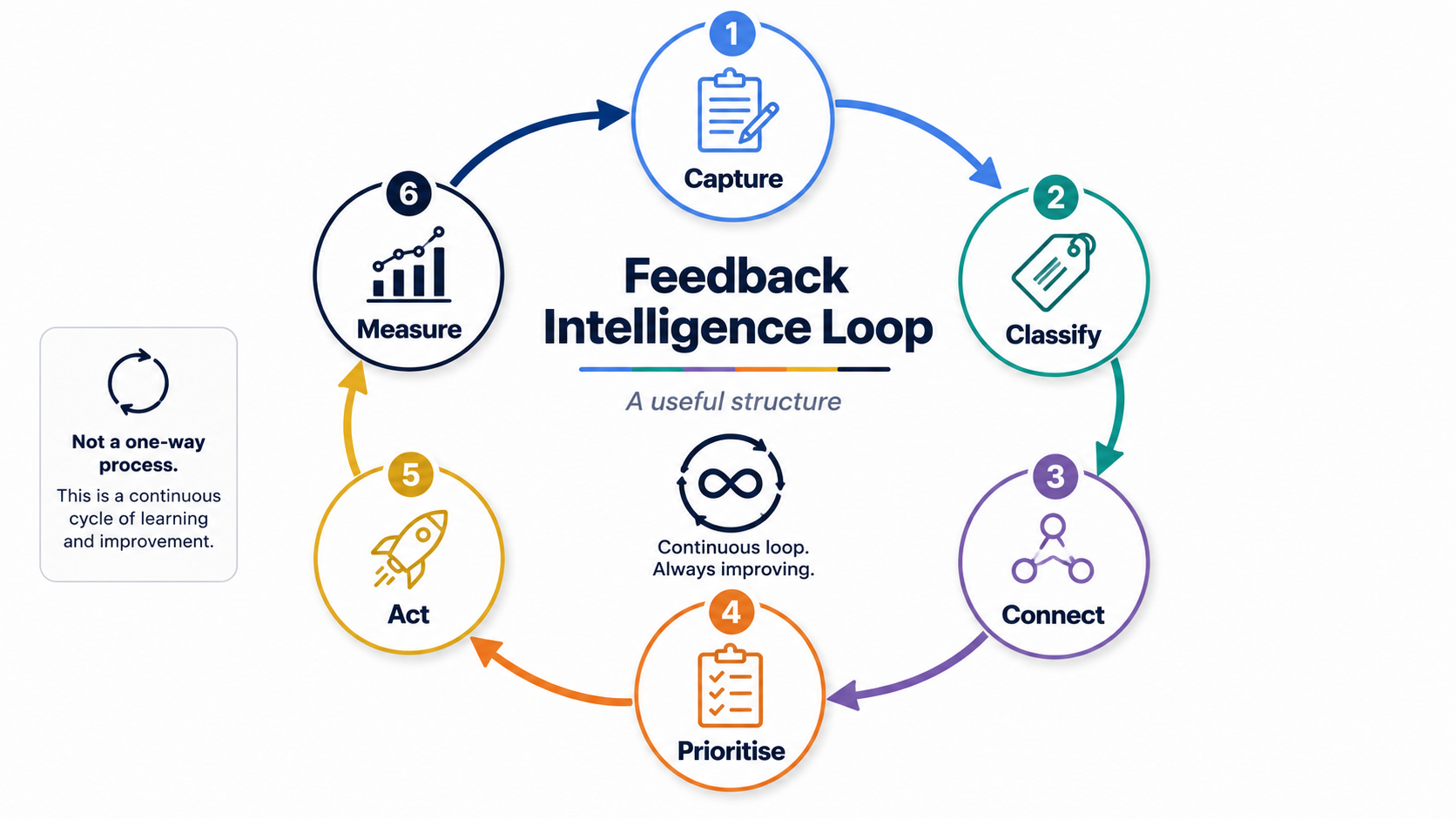
Feedback Intelligence Loop
Capture → Classify → Connect → Prioritise → Act → Measure
This loop helps teams move from passive survey collection to active customer intelligence.
1. Capture feedback at meaningful moments
The goal is not to ask customers more questions. Customers already receive enough surveys to qualify for diplomatic immunity.
The goal is to ask the right questions at the right moments.
For a fintech company, those moments may include onboarding, KYC completion, a failed transaction, a support escalation, a fraud review, an account upgrade, or a renewal milestone.
For a B2B SaaS company, useful feedback may come from onboarding surveys, in-app prompts, support tickets, churn interviews, product usage patterns, review sites, and customer success notes.
This is especially important for B2B SaaS customer feedback, where the buyer, user, admin, and decision-maker may all have different experiences. A product user may complain about usability, while the account owner may care more about reporting, integrations, or renewal value.
Customer feedback is no longer limited to survey forms. It now appears across support tickets, reviews, in-app comments, renewal calls, social channels, and customer success notes. The customer journey does not politely confine itself to one feedback channel for our administrative convenience.
2. Classify responses using AI
Once feedback is captured, it needs structure.
A spreadsheet full of customer comments is not intelligence. It is just a swamp with filters.
This is where AI customer feedback analysis can create real value.
AI can help classify responses by topic, sentiment, urgency, product area, customer type, journey stage, likely team owner, and business impact.
For example, a fintech platform may receive hundreds of comments about onboarding. AI customer feedback analysis can group those comments into clearer themes, such as identity verification confusion, unclear document requirements, slow approval updates, or poor status messaging.
That level of structure helps teams move from “Customers are unhappy” to “Customers are struggling with a specific step in the onboarding journey, and this is affecting activation.”
That is the difference between noise and intelligence.
3. Connect feedback to business context
Feedback becomes far more powerful when connected to commercial and operational data.
“Onboarding is confusing” is useful.
But this is much more useful: “Onboarding confusion is concentrated among UK SME fintech customers in their first 14 days, appears most often after KYC document upload, and correlates with lower activation and higher support volume.”
Now the feedback is no longer just a comment. It is a business issue with a likely owner, priority, and measurable outcome.
This is particularly important for fintech customer experience. Fintech customers often interact with sensitive processes such as payments, identity checks, fraud reviews, compliance workflows, account approvals, and transaction failures. A poor experience in these moments can damage trust quickly.
Klarna offers a useful recent example of feedback being routed into internal action. In 2025, it launched an AI-powered feedback hotline using a virtual version of its CEO, allowing consumers to share product feedback, issues, and suggestions through a conversational interface.
Yes, an AI CEO hotline sounds like a Black Mirror intern project. But the operating lesson is real: customer feedback becomes more valuable when it flows into team workflows.
In fintech, customer feedback is not just about satisfaction. It can reveal trust gaps, compliance friction, operational risk, and churn signals.
4. Prioritise what matters most
Not all feedback deserves the same response.
A mature customer intelligence platform should help teams decide what to fix first. This is where customer feedback prioritisation becomes essential.
A practical prioritisation model might look like this:
- Urgent customer risk: High-value or regulated customers likely to churn.
- Repeated friction: Issues appearing across multiple customers or segments.
- Revenue opportunity: Feature requests linked to expansion or renewal.
- Product defect: Bugs or usability issues hurting adoption.
- Nice-to-have suggestion: Isolated requests with limited immediate impact.
This prevents teams from treating every comment equally. That may sound fair, but operationally, it is nonsense wearing a tiny crown.
A complaint affecting 200 customers and a suggestion from one bored power user should not enter the roadmap with the same weight. Customer feedback prioritisation helps product, support, and leadership teams focus on the feedback that has the greatest impact.
5. Turn insight into workflow
Insight without ownership is reporting theatre.
Once feedback is classified and prioritised, it should trigger action. This is where customer feedback workflow automation becomes a major differentiator.
For example:
- Product teams should receive recurring feature complaints grouped by theme.
- Customer success teams should be alerted when a strategic account signals frustration.
- Support leaders should see repeated service issues by segment.
- Leadership should see which feedback themes are linked to churn, adoption, or revenue.
- Product managers should be able to track whether fixes reduce future complaints.
The wider B2B SaaS market is already moving in this direction. Salesforce has positioned Agentforce as part of a shift toward AI-supported customer operations, with Salesforce reporting that Agentforce resolved more than 84% of customer questions on help.salesforce.com after handling more than 500,000 customer conversations.
For OpenSurveyCraft, the opportunity is not simply to summarise feedback. The opportunity is to route it, assign it, track it, and measure whether anything changed.
Radical concept: doing something after asking customers what they think.
6. Measure and close the loop
One of the most overlooked parts of feedback management is telling customers what happened after they shared their input.
This is the foundation of closed-loop customer feedback.
Closed-loop customer feedback means companies do not simply collect responses and disappear. They acknowledge issues, take action, and communicate what changed.
For example:
- “You told us onboarding was unclear, so we simplified the setup flow.”
- “You flagged payment failure confusion, so we added clearer status messages.”
- “You asked for better reporting, so we launched exportable insight summaries.”
This builds trust. It also improves future feedback quality. Customers are more willing to share honest, useful feedback when they believe the company is listening and acting.
Without a closed loop, customers learn that surveys are just corporate confetti.
Measurement also matters internally. Teams should be able to see whether actions taken after feedback actually reduce future complaints, improve activation, lower support volume, improve retention, or increase renewal confidence.
That is what separates a feedback programme from a feedback intelligence system.
How OpenSurveyCraft helps teams move from feedback to action
OpenSurveyCraft is built around a simple principle: feedback should not end in dashboards.
It should flow into workflows, ownership, prioritisation, and measurable customer improvement.
With OpenSurveyCraft, teams can move through the full Feedback Intelligence Loop:
- Capture feedback at meaningful customer moments.
- Classify responses by topic, sentiment, urgency, and customer intent.
- Connect feedback to customer context, journey stage, segment, and business value.
- Prioritise themes based on risk, recurrence, revenue impact, and customer importance.
- Act by routing insights to the right teams and owners.
- Measure whether actions reduce friction and improve customer outcomes.
This is especially powerful for B2B SaaS customer feedback and fintech customer experience, where customer signals often connect directly to adoption, trust, retention, renewal, and revenue.
Final thoughts
Survey responses are not the destination. They are the raw material.
The real value lies in turning responses into intelligence: structured, contextual, prioritised insight that teams can act on.
For OpenSurveyCraft, the positioning opportunity is clear. The product should help businesses move from passive survey collection to an active customer intelligence platform. That means capturing feedback at meaningful moments, using AI customer feedback analysis, enabling open-text feedback analysis, applying customer feedback prioritisation, supporting customer feedback workflow automation, and helping teams build closed-loop customer feedback systems.
Customers are already telling businesses what they need.
The companies that win will be the ones that listen properly, understand the signal, and act before the same issue becomes a churn report, a lost renewal, or a competitor’s smug little case study.
Ready to move beyond survey dashboards? OpenSurveyCraft helps teams classify feedback, prioritise what matters, assign ownership, and close the loop with customers. Talk to us today.