Every organisation wants customer feedback, but very few design surveys that customers actually finish.
If you have ever launched a customer satisfaction survey only to see low completion rates or partial responses, the issue is rarely the customer. It is usually the survey experience itself. Customers are not unwilling to share feedback. They are unwilling to invest time in something that feels confusing, irrelevant, slow, or untrustworthy.
Recent research reinforces this shift. A 2026 analysis of survey behaviour found that response rates are increasingly influenced by trust, relevance, and timing, rather than just questionnaire structure. Even well-designed surveys can underperform if the experience feels disconnected or unclear to respondents. A 2026 analysis of survey behaviour suggests that the experience matters as much as the survey itself.
For teams focused on customer insight, especially in financial institutions, this challenge is even more critical. Whether you are running financial surveys, gathering customer feedback in banks, or trying to improve a specific journey, the quality of your insights depends entirely on whether customers choose to engage and complete the survey.
The reality is simple. High completion rates are not accidental. They are intentionally designed.
Start with a clear purpose
Most surveys fail because they try to achieve too many objectives at once. A single questionnaire attempts to measure satisfaction, understand behaviour, test messaging, and gather open feedback all at once. This leads to long, unfocused surveys that feel like work rather than a simple interaction.
Customers can sense this immediately. When a survey lacks focus, it becomes harder to stay engaged.
A focused customer satisfaction survey consistently performs better because it respects the customer’s time and attention. This is aligned with broader customer experience research. PwC’s 2025 Customer Experience report highlights that 52% of customers disengage after a poor experience, which includes poorly designed feedback interactions.
Make the survey feel trustworthy from the first click
Trust begins before the survey even opens.
If the link looks unfamiliar, generic, or disconnected from the organisation’s domain, customers hesitate. In customer feedback in banks, this hesitation is amplified because customers are conditioned to avoid suspicious links.
A survey must feel like it belongs to the organisation. The URL should be recognisable, the design should reflect the brand, and the experience should feel consistent with the company’s digital presence. When a survey looks like it came from a third-party tool rather than the organisation itself, response rates drop before the first question is even seen.
Trust is not just a design choice. It is a participation driver.
Set the tone with the first question
The first interaction determines whether the survey continues or ends.
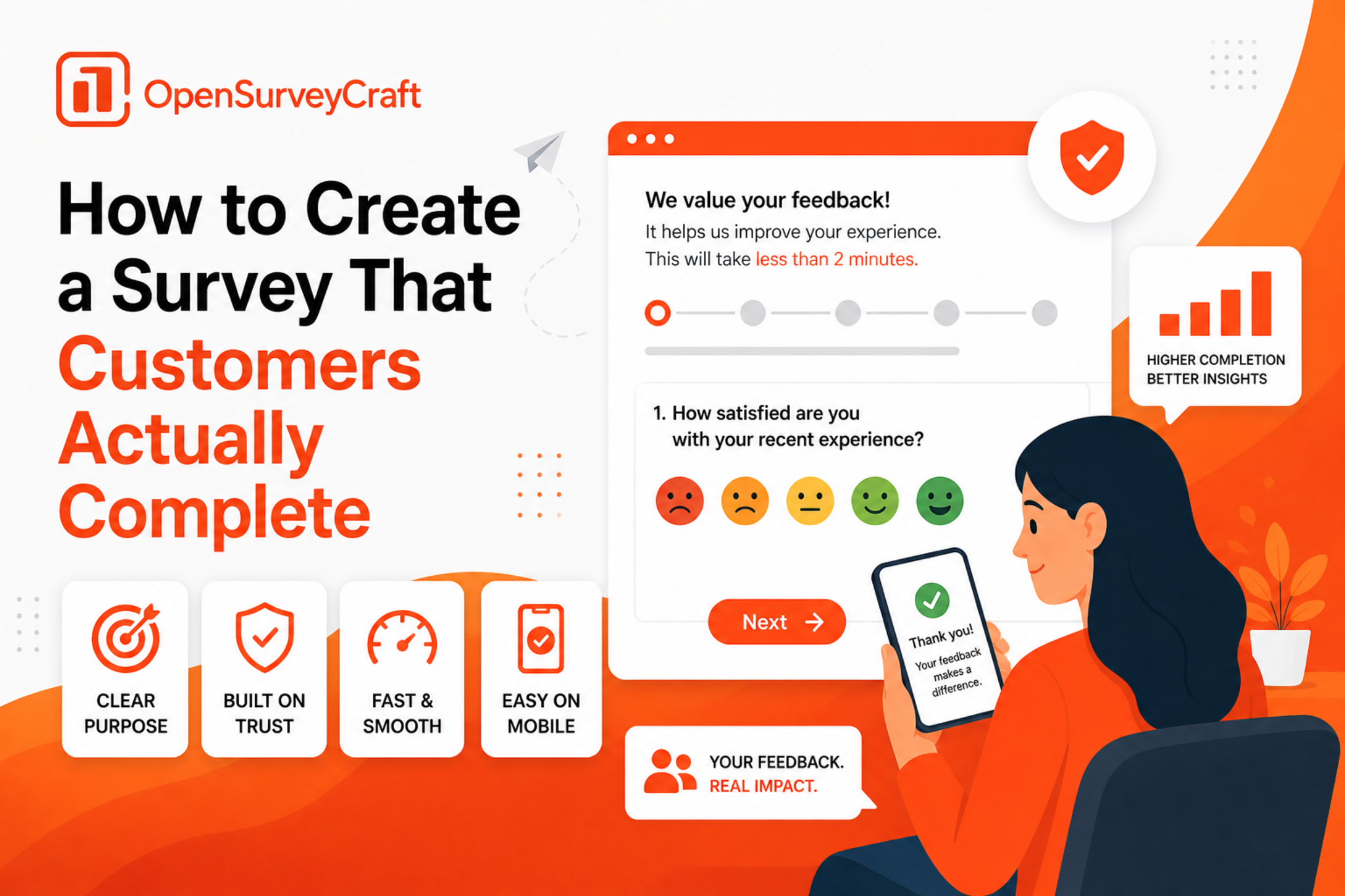
Instead of immediately asking for ratings, the survey should provide context. Customers should understand why they are being asked for feedback and what value it brings to them. This does not mean adding paragraphs and paragraphs of information but just a simple: “We’re collecting your feedback to improve your experience with Fixed Deposits, and this will take less than 2 minutes.”
This is where the “what’s in it for me” matters.
A strong opening creates a sense of purpose. It reassures customers that their feedback will lead to improvements and not just sit in a report. Research in 2026 shows that surveys framed as listening tools rather than data collection exercises perform significantly better in completion rates. Research in 2026 also points to trust and framing as completion drivers.
When customers feel heard, they continue.
Respect the customer’s time and attention
Customers evaluate surveys based on effort, not duration. Even a short survey can feel long if it is repetitive, unclear, or poorly structured.
Industry benchmarks show that external surveys typically achieve only 20–30% response rates, highlighting how difficult it already is to capture attention. Every unnecessary question reduces the likelihood of completion. Every additional step adds friction. Industry benchmarks show just how narrow the margin is.
In financial surveys, where customers may already be cautious, the margin for error is even smaller.
Make the experience fast and seamless
Speed is one of the most underestimated factors in survey completion.
Questions should load instantly. Transitions should feel smooth and uninterrupted. Any delay creates friction.
Modern users are used to fast, responsive digital experiences. If a survey feels slow or unstable, they disengage. Research into digital experience behaviour shows that even small delays can significantly increase drop-off rates across online interactions.
A survey should feel effortless. Smooth, responsive, and immediate.
Keep interactions simple and intuitive
The effort required to respond plays a major role in completion.
Customers should be able to answer most questions with a single click or tap. Complex inputs, excessive typing, or multi-step interactions increase cognitive load. Submission should also be straightforward. Customers should not have to navigate confusing flows or multiple confirmation steps. The path from start to finish should feel natural.
This aligns with broader usability principles seen in digital product design, where reducing interaction effort directly improves completion rates.
Make every question relevant and adaptive
Relevance is one of the strongest predictors of completion.
Customers expect surveys to reflect their experience. When they encounter irrelevant questions, engagement drops immediately.
Modern survey approaches are increasingly context-driven and adaptive, where questions change based on previous responses. Research shows that this type of dynamic questioning improves both completion rates and data quality.
For example, in surveys for banks, a customer who only uses mobile banking should not be asked about branch visits. When surveys adapt, they feel more like conversations and less like forms.
Avoid repetition and unnecessary questioning
Repeated questions are one of the fastest ways to lose respondents.
When customers feel they are being asked the same thing multiple times, it signals poor design and reduces trust. Surveys should move forward, not loop back.
Each question should add value. If it does not, it should not be included.
Design for mobile-first experiences
SurveyMonkey’s 2025 research found that nearly 60% of surveys are completed on mobile devices, making mobile-first design essential.
This changes how surveys should be built. Long grids, dense text, and complex layouts do not work well on mobile.
A survey should be easy to read, easy to navigate, and quick to complete on smaller screens. Poor mobile design directly impacts completion rates.
Ensure the survey always looks polished
Visual quality affects trust and engagement.
A survey should never feel broken, inconsistent, or outdated. Issues like misaligned elements, slow rendering, or poor design reduce credibility.
Customers associate the quality of the survey with the quality of the organisation. A polished experience reinforces trust. A poor one undermines it.
Close the feedback loop
Customers are more likely to participate when they believe their feedback matters.
Closing the loop by acknowledging responses and demonstrating action builds long-term engagement. It reinforces the idea that the organisation is listening.
Research also shows that response rates increasingly reflect relationship strength, not just survey design. When customers see impact, they are more willing to engage again.
A better way to build surveys
Creating surveys that customers actually complete requires both the right approach and the right tools. OpenSurveyCraft is designed to support this. As an open source, AI-enabled platform, it helps organisations build surveys that are fast, adaptive, and aligned with their brand.
From ensuring surveys feel trustworthy and load seamlessly to enabling dynamic, responsive questionnaires, OpenSurveyCraft focuses on creating better experiences for both customers and research teams. For organisations running financial surveys and surveys for banks, it also ensures data privacy and compliance without compromising usability.
Surveys are not just feedback tools. They are moments of interaction that shape perception.
Final thoughts
Customers are willing to share feedback, but their attention is limited and their expectations are high.
When surveys are clear, fast, relevant, and trustworthy, completion rates improve naturally. The quality of customer insight increases, and organisations are better equipped to act on feedback.
At its core, a survey is not just a tool for collecting data. It is an experience. At OpenSurveyCraft, we are dedicated to building this experience tailored to your brand. Get in touch with us today to explore how you build surveys that customers actually complete.
OpenSurveyCraft helps organisations build better surveys for customer feedback, financial surveys, and research teams that care about completion, trust, and insight quality.