Customer research is meant to help organisations move faster, make better decisions, and stay closer to their customers. In reality, many teams experience the opposite. Surveys take too long to design, approvals drag on, tools feel restrictive, and by the time insights are ready, the business has already moved on.
If you are responsible for customer satisfaction surveys, distributor satisfaction surveys, or broader customer research in banks, insurers, or heavily compliance-driven organisations, this situation is likely familiar. The problem is not a lack of intent or effort. It is that most survey tools were not designed for the complexity, compliance, and scale required by modern financial institutions.
Customer experience programmes are most effective when they deliver insights quickly enough to influence decisions in real time. Yet in practice, many organisations struggle to close this gap between data collection and action.
Too much focus on collection, not insight
Most survey tools are designed primarily to collect responses. They follow a structure of question after question, more like forms than insight-driven surveys. They provide dashboards and charts, but often fall short when it comes to helping teams translate data into action. Many surveys fail miserably: they either create incorrect insights because teams spend time connecting the dots between responses, or they simply need to be discarded because the journey is disconnected. This happens because users get too caught up in setting up the survey tool and adding questions. They lose the big picture: the main goal of a survey is insight.
This creates a gap between gathering feedback and making decisions. A well-executed customer satisfaction survey should lead to clear recommendations and measurable improvements. Without that, surveys risk becoming routine exercises in data collection rather than drivers of business value.
In fintech and digital banking environments, where speed and responsiveness are key competitive factors, this gap can directly impact customer experience and growth.
Survey design is still too cumbersome
Survey design should be the simplest part of customer research, yet it is often one of the most time-consuming. Survey design is an important deciding factor for survey response quality and quantity. While basic templates may work for simple use cases, real-world scenarios quickly demand more flexibility. As soon as teams need conditional logic, personalised flows, multilingual versions, or surveys tailored to different stakeholder groups, the process becomes slow and frustrating.
For teams working on surveys for organisations offering a variety of products and services, such as banks, insurers, and financial institutions, this limitation is especially restrictive. These organisations deal with complex customer journeys, multiple touchpoints, and varied user segments. Instead of enabling this complexity, many tools force teams to simplify their approach. Questions are often adjusted to fit the tool rather than the research objective, and irrelevant options are introduced just to make the survey flow work.
Clear, well-structured questions improve response quality. However, achieving that clarity often requires significant manual effort when tools lack flexibility.
Poor design impacts response quality
The design of a survey plays a crucial role in how customers engage with it. Many traditional tools still produce surveys that look generic, outdated, and disconnected from the brand experience. In industries like banking and insurance, where trust and consistency matter, this creates a noticeable gap.
Customers who are used to polished, personalised digital experiences from social media platforms, such as Facebook, Instagram, LinkedIn, and TikTok, are suddenly presented with surveys that feel impersonal. This affects participation rates, completion rates, and the quality of responses. SurveyMonkey itself notes that survey design and user experience directly influence response rates and engagement. Moreover, for industries that deal with finance and cash management, customers are more careful before clicking or responding to anything. We all have that friend or an old aunt who clicked on a link sent by their bank and lost a bunch of money. That is why people refrain from clicking on anything that looks like it came from their bank but has a fishy look and feel.
A customer satisfaction survey should feel like a natural extension of the organisation's brand. When it does not, the quality of customer insight declines.
Approval cycles create unnecessary delays
In financial institutions, surveys rarely move from design to launch in a straight line. They pass through multiple layers of review, including compliance, legal, branding, and internal stakeholders. This is necessary, but most survey tools do not support these workflows effectively.
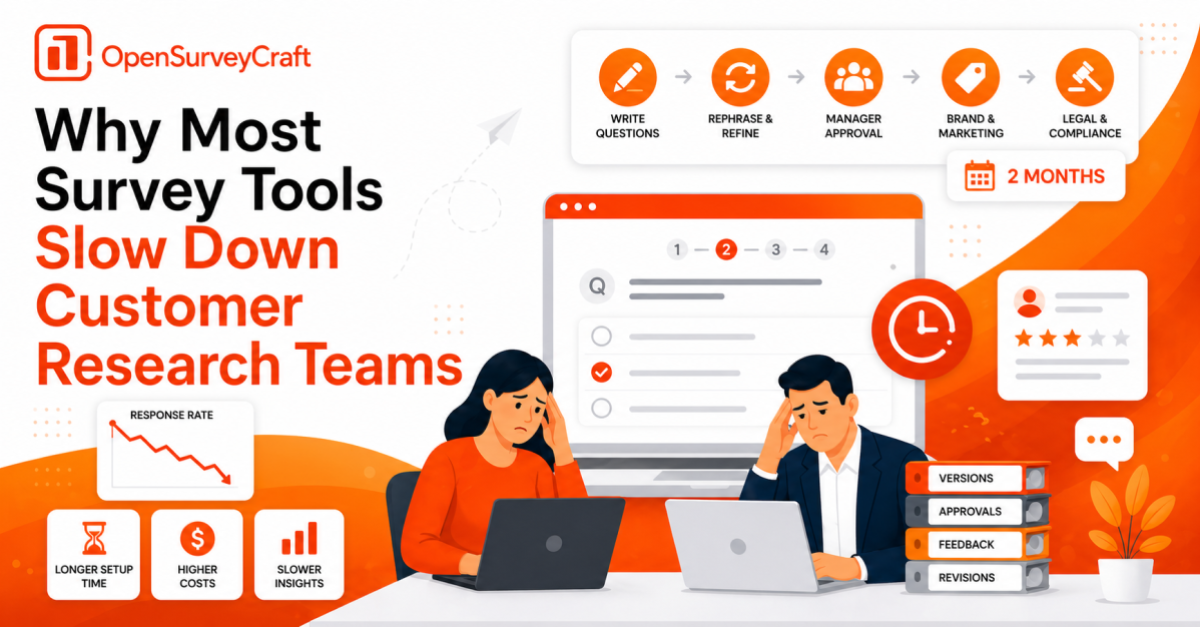
In reality, designing and approving a survey can easily become a two-month activity. It often begins with drafting questions, which are then reworked multiple times to improve clarity and tone. The survey is reviewed by a manager, then passed to brand and marketing teams that may request changes to wording or structure. Legal and compliance teams then assess whether the questions meet regulatory requirements, often flagging seemingly simple wording for revision.
This leads to repeated cycles where a single question is rewritten several times, not because the objective has changed, but because each stakeholder evaluates it differently. By the time the survey is approved and ready to launch, weeks have passed, and the original business context may already have shifted.
In regulated environments, this is not just inefficiency. It is a structural slowdown in how customer research operates.
Data residency and security concerns
For heavily guarded industries such as financial institutions, data security and compliance are critical. Survey tools must align with strict regulatory requirements around data storage, access, and governance. They also need to control who gets access to customer data, including contact details, transaction types, and other sensitive information.
Regulators such as the Financial Conduct Authority (FCA) and global standards bodies continue to emphasise data protection and operational resilience.
Most survey platforms do not allow self-hosting, instantly becoming non-compliant for organisations that do not want their customer data to be anywhere except their own infrastructure. Most build-versus-buy debates are won by build in such instances, despite that usually meaning a team of developers, basic designs, long development timelines, and significant costs. When survey platforms do not provide clear control over data residency or lack self-hosting capabilities, organisations are forced to either avoid them or build complex workarounds. Both options slow down customer research and increase operational risk.
Vendor lock-in and pricing models slow scale
Another common challenge lies in how survey tools are structured and priced. Many platforms rely on pay-per-response models, which can become expensive as customer research scales. For organisations that need to regularly survey large customer bases, this creates a direct trade-off between cost and insight.
In addition, vendor lock-in limits flexibility. We all have used at least one platform that we get completely frustrated with, but have to use daily because it does something right. Does Adobe, Microsoft 365, or SAP ring a bell? Everything revolves around what is possible within the platform. Teams often find it difficult to customise the platform, access raw data freely, or integrate with existing systems. It takes forever to configure the system to create surveys that are closest to the actual requirement.
For surveys for banks and insurers, where scale and control are essential, these limitations can significantly slow down research efforts.
Lack of flexibility limits meaningful insights
Effective customer research requires more than standard question formats and basic branching logic. It requires adaptability based on context, behaviour, and user segments. Many tools, however, are built for generic use cases and struggle to support more nuanced research needs.
For example, a distributor satisfaction survey may need to vary based on region, product type, or relationship tenure. Without the ability to customise flows and tailor questions dynamically, surveys become overly generic. And when surveys are generic, the insights they produce are often too broad to drive meaningful action. Why ask a question that will have Not Applicable or Others as an answer, anyway?
Capturing contextual feedback generates actionable insights. Without flexibility, this becomes difficult to achieve at scale.
What customer research teams actually need
- Complex survey design without cumbersome setup.
- Collaboration and approvals built into the workflow.
- Seamless, brand-consistent experiences for respondents.
- Scalable pricing, self-hosting, and stronger data control.
A better approach with OpenSurveyCraft
OpenSurveyCraft is built to address these challenges. As an open source, AI-enabled platform, it is designed to support modern customer research without the limitations of traditional survey tools.
For organisations in banking and insurance, OpenSurveyCraft offers the flexibility needed to design complex surveys while ensuring that each survey feels like a true extension of the brand. Its self-hosted deployment option allows organisations to maintain control over their data, supporting both privacy and regulatory requirements.
Whether you are running a customer satisfaction survey, a distributor satisfaction survey, or large-scale surveys for banks and insurers, OpenSurveyCraft helps streamline the process and focus on what matters most: understanding customers and acting on their feedback.
Final thoughts
Survey tools should accelerate customer research, not slow it down. Yet many organisations continue to rely on systems that introduce friction at every stage, from design and approvals to execution and analysis.
For teams in financial institutions, where speed, accuracy, and trust are critical, this is no longer sustainable.
Better tools lead to better surveys.
Better surveys lead to better insights.
Better insights lead to better decisions.
That is the real purpose of customer research.
Stay tuned for more from us and if you want to know how we can help you understand your customers better, reach out at contact@opensurveycraft.com.